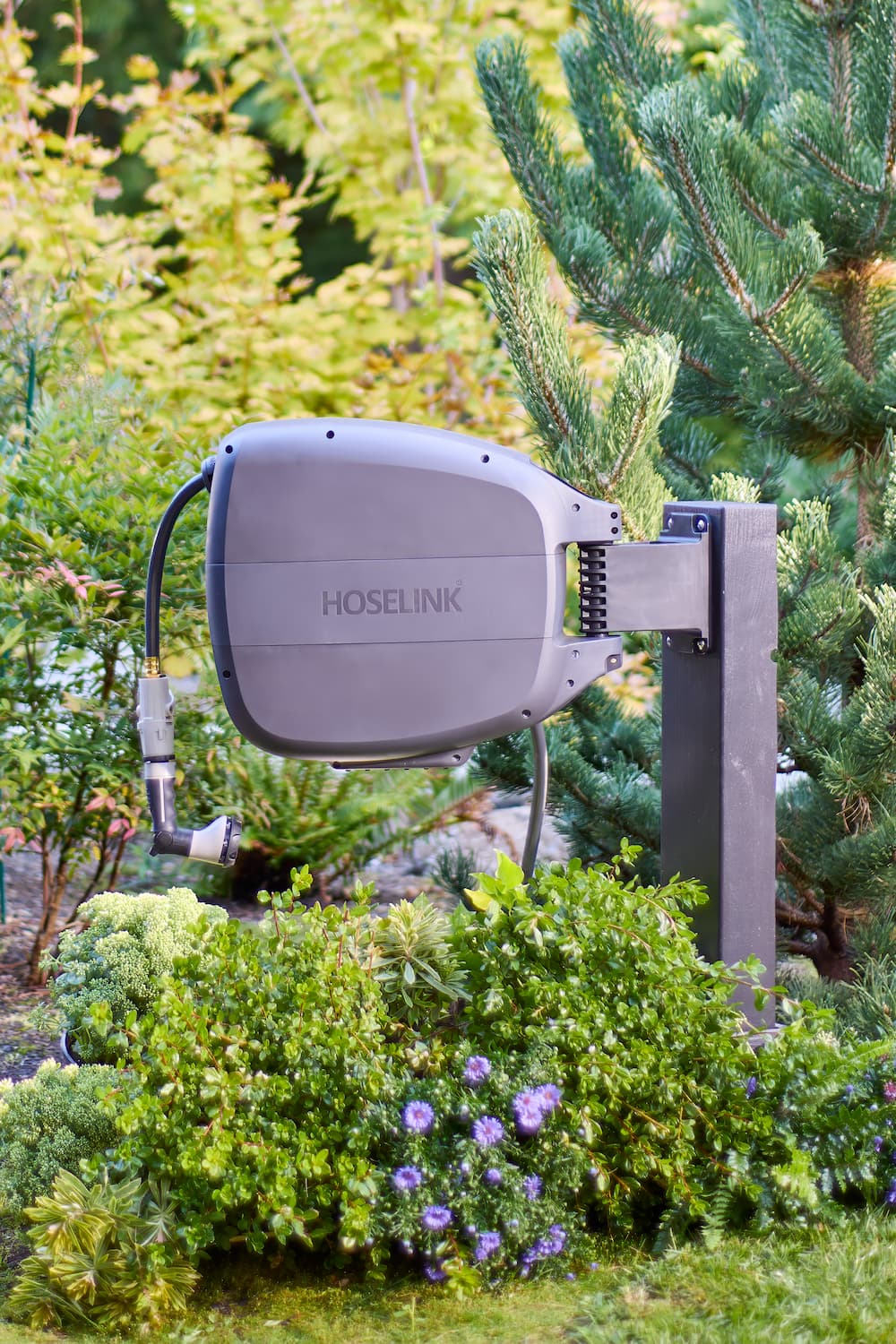
The tidiest way to store a garden hose is a wall-mounted retractable reel, which winds the hose away automatically and keeps it off the ground entirely. Hose pots and hangers are cheaper but still need manual coiling. Whatever you choose, getting the hose off the lawn is what eliminates trip hazards and stops kinks shortening its life.
A garden hose spends most of its life not being used. How you store it during that time decides two things: whether your yard looks tidy, and how long the hose lasts. A hose left coiled on the grass gets walked on, mown over, baked by UV, and kinked in the same three places until it splits.
There is no single right answer here. A courtyard with a 25ft hose and a half-acre yard with 100ft have very different needs. Here are the seven realistic options, what each is actually good at, and where each falls down.
1. Wall-mounted retractable reel
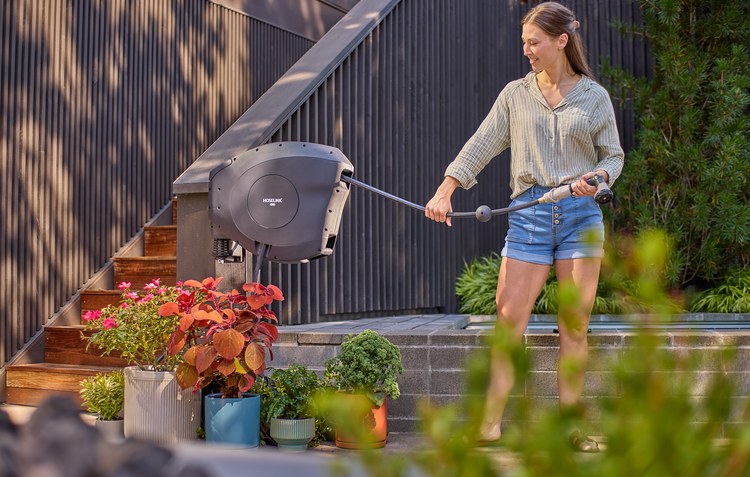
The hose lives inside an enclosed housing bolted to the wall and winds itself away when you are done. This is the tidiest option available and the only one that removes the coiling job entirely, which matters, because manual coiling is the step people skip, and skipping it is how hoses end up on the ground.
It is also the best answer to the trip-hazard problem, because the hose is fully off the ground between uses rather than looped over a hook with a tail on the floor.
The trade-offs are honest ones: it is the most expensive option, and it needs a solid wall and a proper fixing. Hoselink's retractable reels come in a 50ft reel and an 82ft reel, so you can match the length to your yard. If you water from two areas, you either move the reel or add a second mounting bracket: Hoselink sells a Second Retractable Hose Reel Bracket ($30.00) for exactly this, so you can unclip the reel and move it between two mounted positions rather than buying a second reel. New to reels? Our retractable hose reel comparison walks through how to choose one.
2. Hose reel cart
A wheeled frame you wind the hose onto and pull around the yard. Useful on large properties where a single fixed point cannot reach everything. Downsides: the hose is exposed to UV, you are still winding by hand, and the carts themselves are bulky things to store. On uneven ground they tip.
3. Hose pot or planter-style container
A decorative container you coil the hose into. Looks good on a patio, hides the hose completely, and costs little. But you are still coiling by hand every time, water pools in the bottom unless it has drainage, and a big hose simply will not fit in a small pot. Best for short patio hoses.
4. Wall hanger or hose hook
The cheapest option that gets the hose off the ground. A simple bracket you loop the hose over. It works, it costs almost nothing, and it is better than the lawn. But the hose stays exposed to sun, the loops sag over time, and a heavy hose on a small hook will eventually pull out of the wall. Use a wide-backed hanger rather than a narrow hook so the hose is not kinked at the hang point.
5. Hose box or storage bin
An enclosed box, often doubling as a bench or deck box, that the coiled hose lives inside. Protects the hose fully from UV and looks tidy. But it is a large object taking up patio space, and it takes the most effort of any option: uncoil, use, coil, lift, put away.
6. Under-deck or overhead storage
Using space you already have: hanging the coiled hose from joists under a deck or on garage rafters. Free, invisible, and completely out of the way. Only realistic for a hose you use seasonally rather than daily, because retrieving it is a job.
7. Leaving it on the ground
Included because it is what most people actually do. It is worth being clear about the cost: a hose on the ground is a trip hazard, gets damaged by mowers and foot traffic, degrades faster in direct sun, and kinks repeatedly in the same spots until it fails. It also makes the yard look untidy in a way that is disproportionate to the size of the object.
Choosing by situation
| Situation | Best option | Why |
|---|---|---|
| Small patio or courtyard | Hose pot or retractable reel | Space is the constraint |
| Standard suburban yard | Wall-mounted retractable reel | Tidiest, no manual coiling |
| Large or multi-area property | Reel plus second wall bracket | Reach without a second hose |
| Rented property | Hose pot or freestanding hanger | No permanent wall fixing |
| Trip-hazard or accessibility | Wall-mounted retractable reel | Hose fully off the ground |
| Seasonal-use hose only | Under-deck or overhead | Free, fully out of the way |
| Tightest budget | Wide-backed wall hanger | Gets it off the ground cheaply |
Storing a hose so it actually lasts
Whatever you store it in, three habits do most of the work.
Drain it before storing. Water left in a hose is weight that stresses the walls, and in cold climates it freezes and splits the hose from the inside. Disconnect, lift one end, and let it run out.
Keep it out of direct sun. UV is what turns a flexible hose brittle. Enclosed storage, such as a reel housing, a box, or a pot, does far more for hose life than the material grade you paid for.
Do not coil it tightly around a small radius. Tight coils set permanent kinks. A wide reel drum or a wide-backed hanger both avoid this; a narrow hook does not.
In winter, bring the hose in if you can, or at minimum drain it fully and disconnect it from the faucet so any residual water has somewhere to expand.
The short version
Get the hose off the ground. A wall-mounted retractable reel does that with the least ongoing effort and protects the hose while it is stored; a hose pot or wide hanger is the budget version of the same idea. Drain it, keep it out of the sun, and do not coil it tight.