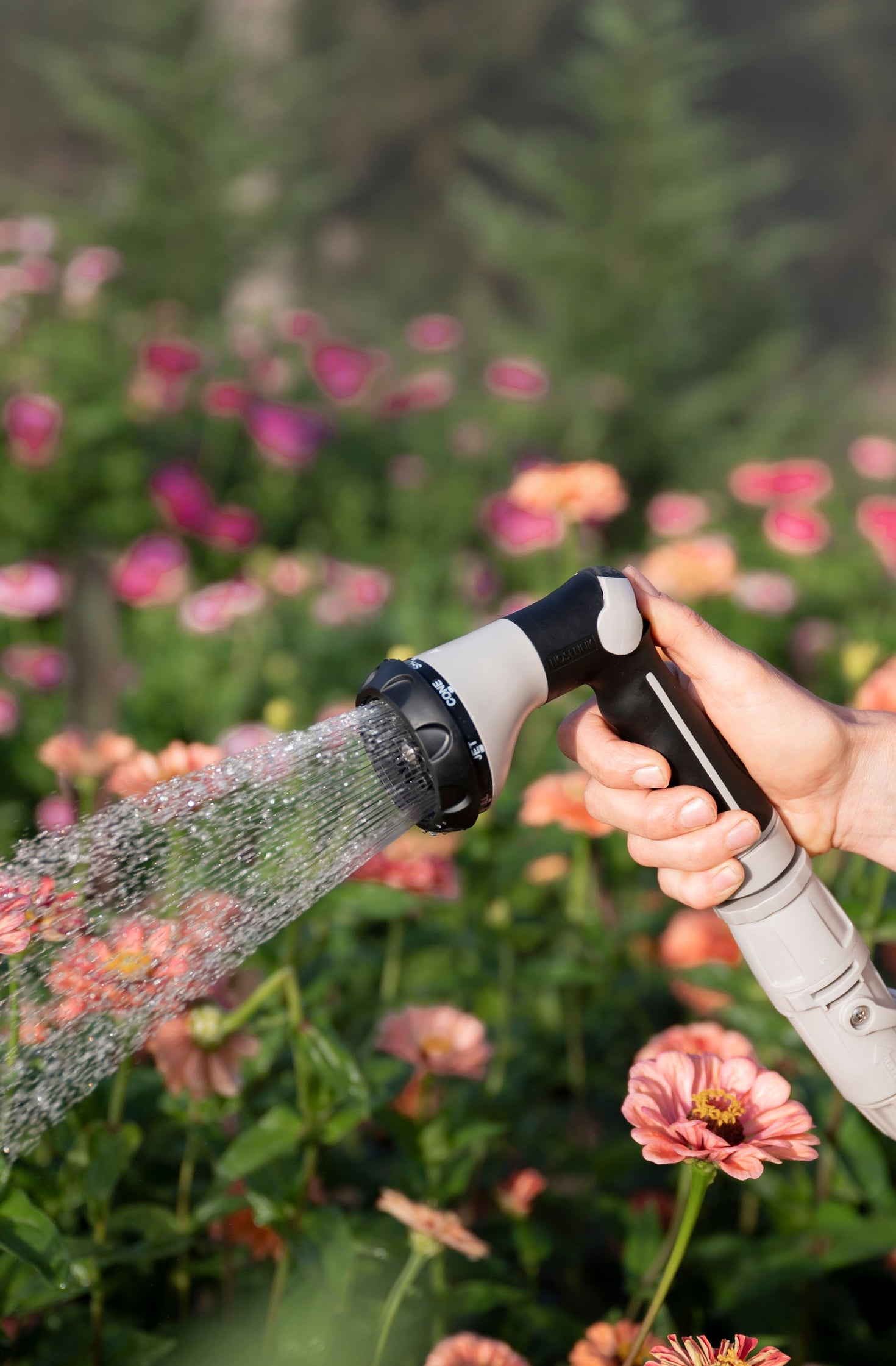
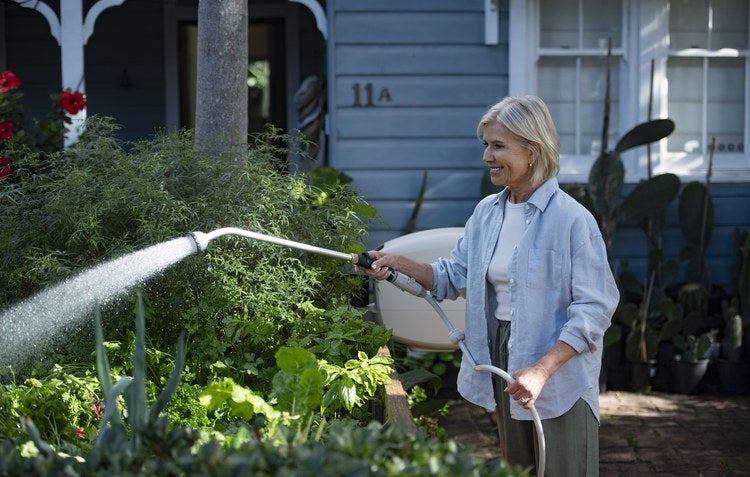
For delicate plants, use a wand with a shower or mist pattern rather than a nozzle set to jet. A wand's long reach lets you water at soil level under the foliage, which is where the water should go, and the wide shower pattern breaks the flow into droplets soft enough not to flatten seedlings or wash potting mix out of pots.
Most hose damage to plants is not caused by too much water. It is caused by water arriving too fast, in too concentrated a stream, from the wrong angle. A jet that is perfect for cleaning a driveway will flatten a tray of seedlings, wash the potting mix out of a hanging basket, and strip leaves off soft new growth.
The fix is not watering less. It is changing how the water leaves the hose.
Wand or nozzle?
The difference is reach, and reach turns out to matter more than most people expect.
A nozzle attaches directly to the hose end and sits in your hand. It is compact, quick to grab, and fine for general watering, washing, and jobs at your feet.
A watering wand puts roughly one to three feet of tube between your hand and the spray head, and extendable models reach further still. That does three things a nozzle cannot: it reaches into the back of a bed without you stepping on the soil, it reaches up into hanging baskets without a ladder or a soaked arm, and, most importantly, it lets you get the head under the foliage to water at soil level.
That last point is the real argument for a wand. Water sitting on leaves largely evaporates and, on many plants, encourages fungal problems. Water at the root zone is water the plant actually uses. A wand is the tool that makes doing it properly effortless, which is why it tends to be the thing keen gardeners buy second and wish they had bought first.
Spray patterns, and which ones are actually for delicate work
Multi-pattern heads all offer a similar set of settings. Only some of them are gentle.
| Pattern | Gentle? | Use it for |
|---|---|---|
| Shower | Yes | Seedlings, pots, general delicate watering |
| Mist / fine | Yes | Propagation, ferns, very young growth |
| Soaker | Yes | Root-zone watering, beds, deep soaking |
| Flat / fan | Medium | Larger established plants, lawn patches |
| Cone | Medium | General watering, medium reach |
| Jet | No | Cleaning only, never on plants |
| Center | No | Distance watering, hard surfaces |
If you take one thing from this: shower and mist are the delicate patterns. Everything else is a compromise, and jet is for concrete.
What actually matters when choosing
Flow control at the handle. This matters more than the pattern count. A thumb-operated flow lever lets you dial the intensity down for a tray of seedlings and back up for a shrub without walking to the faucet. Our Long-reach Shower Spray Wand, for example, has exactly this kind of thumb lever at the grip. Without it you are stuck with whatever your faucet is set to.
Reach, matched to your yard. A shorter wand is easier to handle and fine for pots and beds you can stand beside. A longer or extendable wand earns its place if you have hanging baskets, deep beds, or raised planters. An extendable one covers both.
Comfort. Watering is a task you do for ten or twenty minutes at a stretch with your arm extended. A soft grip and a trigger lock, which holds the flow on so you are not squeezing continuously, make a real difference over a session, and a big one if you have any hand or wrist pain.
Build quality. The failure point on cheap wands is the joint where the head meets the tube, and the seal inside the valve. Metal-bodied heads and quality internal seals are what separate a wand that lasts seasons from one that drips down your arm by the second summer.
Matching the tool to the job
Seedlings and propagation trays: a fine mist or shower pattern, with the flow turned well down. Water the tray, not the seedlings, and let it wick up if you can.
Hanging baskets: a long-reach or extendable wand on shower. Baskets dry out faster than anything else in the yard and are the single most awkward thing to reach, which is exactly the problem a wand solves.
Established beds: a longer wand on soaker or shower, head held low, watering the soil rather than the plants. Fewer, deeper waterings beat frequent light ones.
Pots and containers: shower pattern, watering until it runs from the drainage holes. A gentle pattern matters here because a hard stream washes potting mix straight out of the top.
Vegetable gardens: soaker or shower at soil level. Keeping water off the foliage genuinely reduces disease pressure on plants like tomatoes and squash.
Root feeding and deep watering: a root waterer, which is a lance you push into the soil to deliver water below the surface, straight to the root zone.
For everyday watering at your feet, a good multi-pattern nozzle like the 7-Function Spray Nozzle covers shower and mist too, and an 8-pattern flow control nozzle adds an adjuster so you can throttle the volume by hand.
The short version
Buy a wand with a shower pattern and a flow-control lever at the handle, and water at soil level rather than over the top of the plant. That single change does more for plant health than any watering schedule. Browse the full range of sprayers and wands to find the one that fits your yard.
Looking for maximum pressure instead of a gentle touch? Our companion guide covers the best high-pressure hose nozzle for cleaning cars, patios, and driveways.